-
Historia
King Herod reigned over Judea, with Jerusalem as his capital, from 40 BCE until his death in 4 BCE.
Herod rose to power with the support of his ally, Roman Emperor Octavian (Augustus), defeating the Hasmonean dynasty. This sparked outrage among much of the Jewish population, who saw Herod as a representative of the Roman Empire that ended the Hebrew dynasty in Jerusalem.
Due to his Jewish ancestry, Herod gained some support from the people of Judea. His close relationship with the Roman Emperor granted him a degree of autonomy over his rule, serving as a bridge between Judea and the Roman Empire.
Throughout his rise to power, Herod made many enemies, which led to a constant sense of persecution. He was pursued by the defeated Hasmonean king Antigonus II, by the family of his wife Miriam, herself of the Hasmonean dynasty, and by the Parthian Empire, Rome’s fierce rival, which supported Antigonus in his fight against Herod. For this reason, Herod likely built fortresses to serve as places of refuge, such as Masada, Mehvar (now in Jordan), and here at Herodium.
It is said of Herod the Great Builder: “What was flat, he made into a mountain; what was high, he leveled; what was desert, he turned into sea; and what was sea, he made into land.” This can be seen in nearly all his constructions. At Herodium, he created a mountain on a flat plain by building a tower and covering it with earth. Like a crater, inside the mountain he theaters, living quarters, and a complex system of cisterns to supply water. Herod’s tomb was also discovered here. -
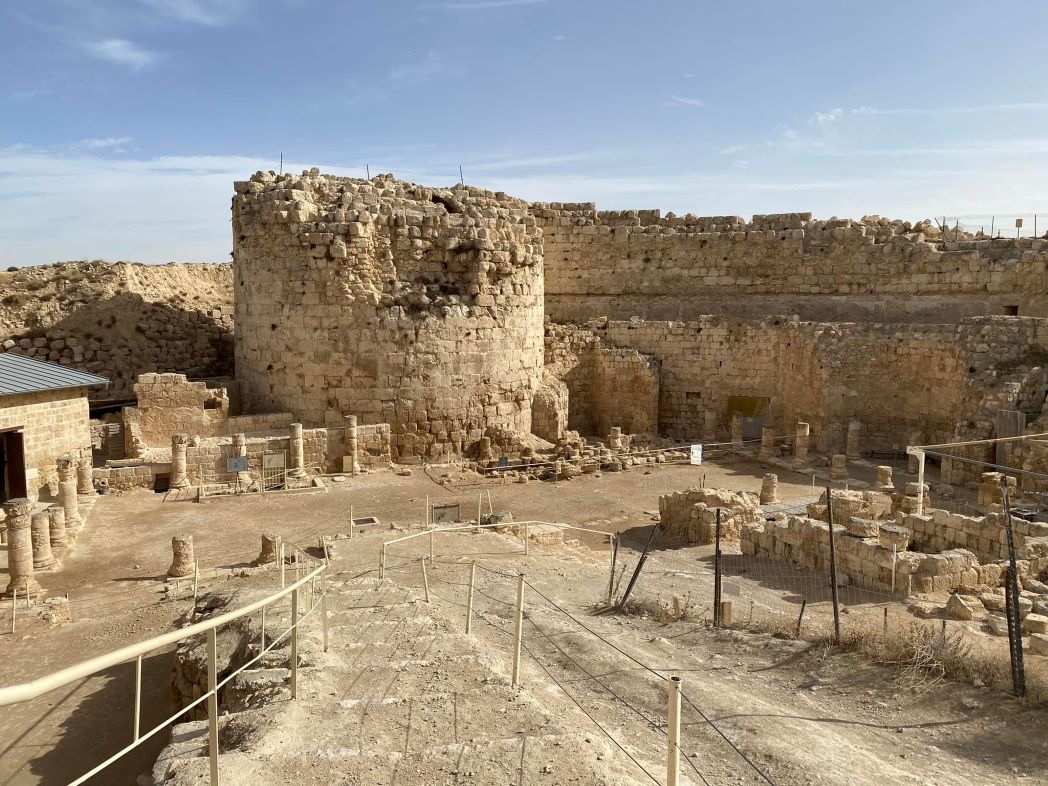 The Fortress:
View of the fortress and its four towers.
From above, you can see the fortress Herod built along the escape route from Antigonus, including the four towers, the courtyard, the bathhouse, the palace itself, and the synagogue.
-
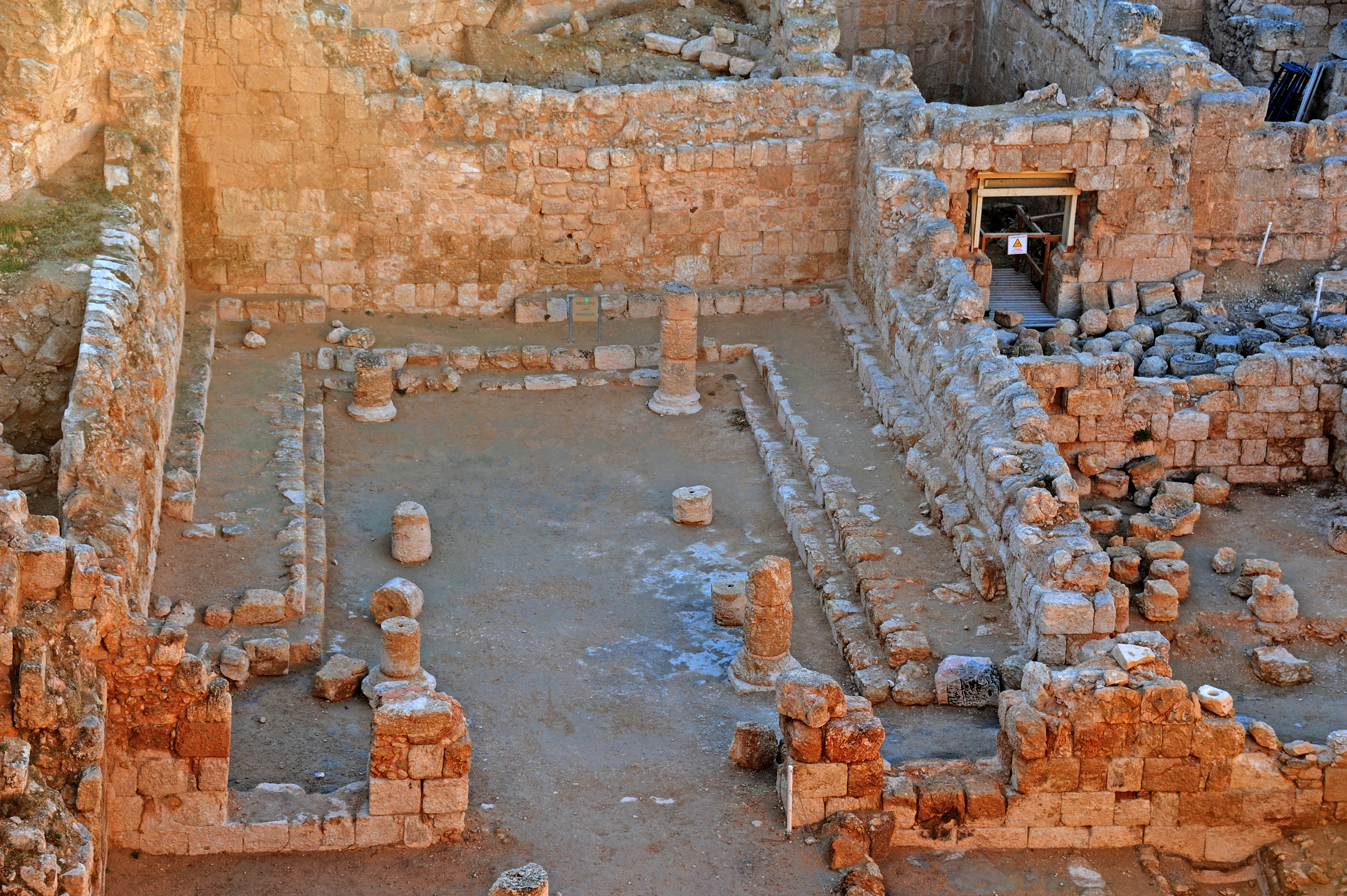 The Synagogue:
The fortress synagogue.
Although one might think Herod built a synagogue to continue the Jewish legacy, especially as he was the builder of the Second Temple, this synagogue was actually adapted by Jewish fighters during the Great Revolt between 66 and 70 CE.
After the fall of Jerusalem, the site was abandoned and later reoccupied by Jewish rebels during the Bar Kokhba revolt in 134 CE. -
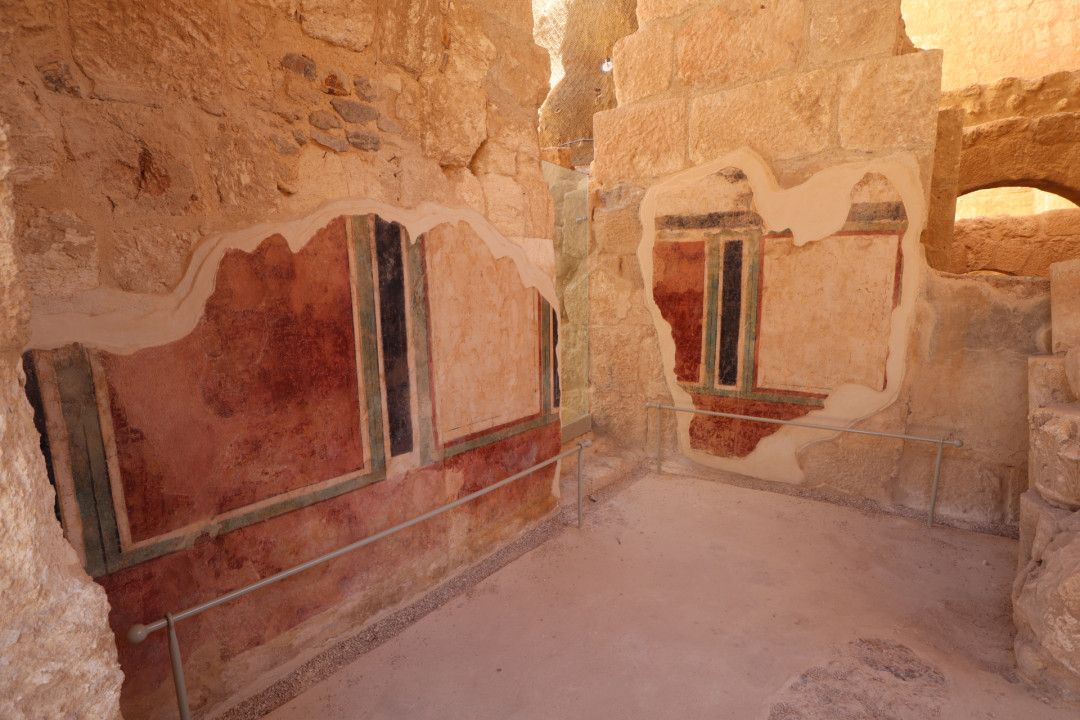 Palace:
Herod’s palace.
It is rare to find frescoes in such condition as those that once adorned the walls of Herod’s magnificent palace. The fresco technique, widely used by the Greeks and Romans, involved painting on fresh plaster, blending the paint with the plaster itself. This gave the artwork a durability that, as seen here, has lasted for over two millennia.
-
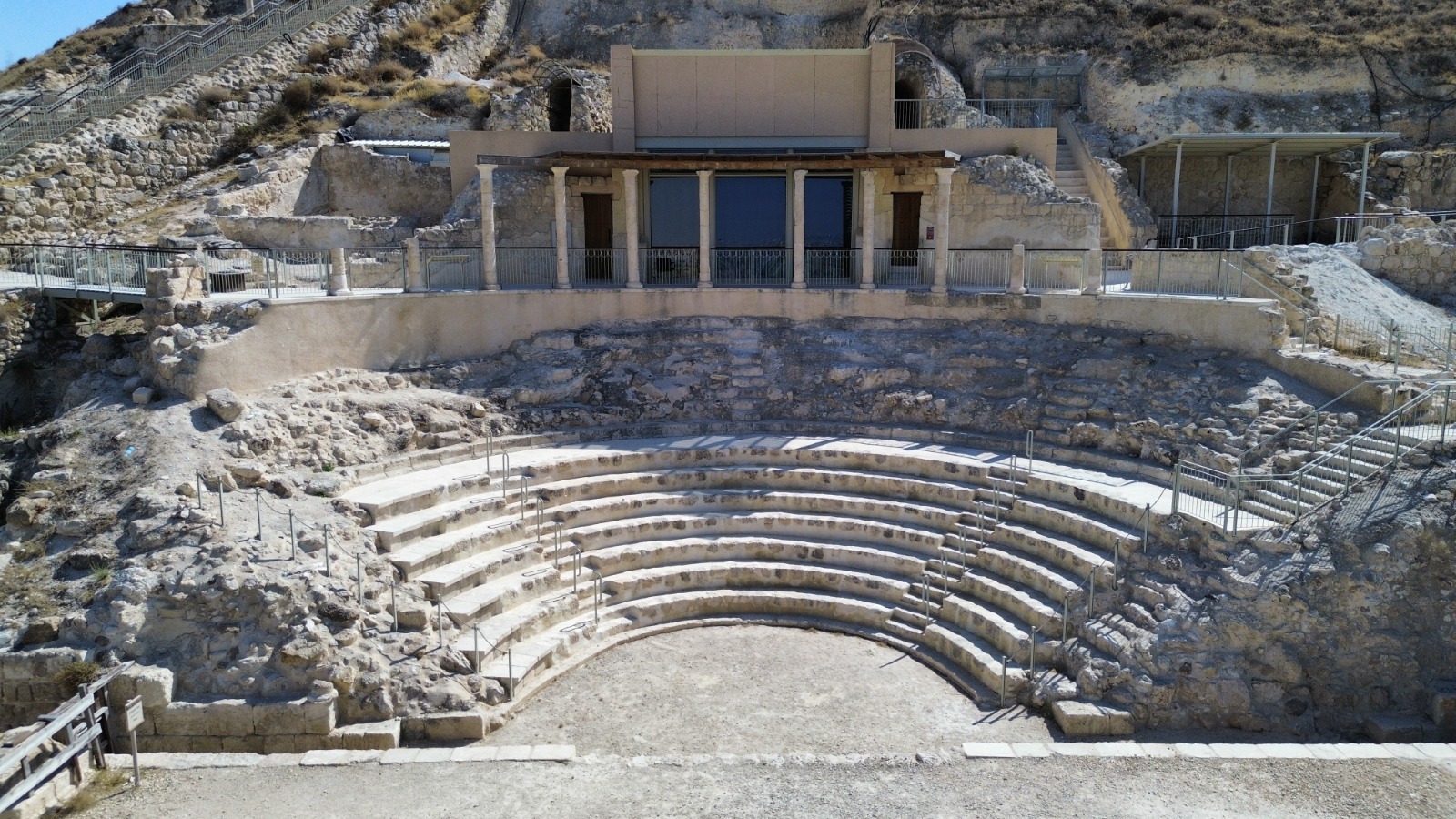 The Theater:
King Herod’s private theater.
Herod built a theater for 400 spectators on the slope of the mountain he himself created. As if that weren’t enough, he also built a VIP lounge to enjoy performances alongside his guests.