-
Historia
Several key events led to the opening of the Land of Israel to the world:
In 1799, Napoleon attempted to conquer the Holy Land from the Turks. Although the campaign failed, it drew global attention back to Jerusalem.
In 1831, Egypt conquered the Land of Israel and began a process of opening up to European empires.
The arrival of steamships enabled a massive influx of pilgrims from Europe.
In 1869, the Suez Canal was constructed, further increasing international interest in the region.
In 1854, the Ottoman Empire became involved in the Crimean War against Russia, forcing it to grant rights to its allies: England, France, and Prussia.
The Ottoman Empire was significantly weakened and lost its ability to reassert dominance over its territories. Once the empires began building outside the walls of Jerusalem, a relatively safe environment emerged for Jewish residents as well. They sought to settle in less densely populated areas beyond the walled city. This marked the birth of the first neighborhoods outside the walls of Jerusalem. Let’s explore some of them: -
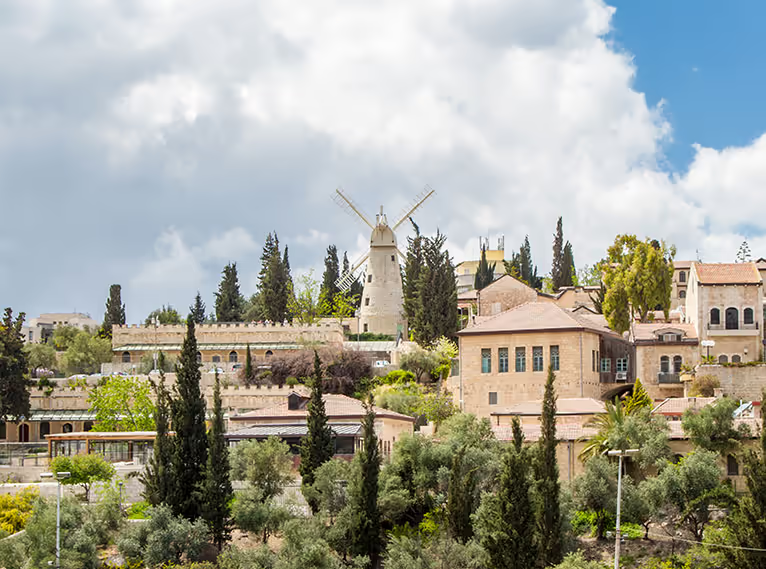 Mishkenot Sha'ananim:
The first Jewish settlement outside the walls of Jerusalem.
Sir Moshe Montefiore, a businessman from London, used to travel the world with his wife Judith. On one of those journeys, he arrived in the Land of Israel. Observing the poor living conditions of Jews within the walls of Jerusalem, low sanitation and almost no medical services, he turned to his friend Judah Touro, an American businessman and philanthropist, to secure the funds needed to purchase the land where this neighborhood now stands.
Montefiore requested permission from the Turkish government to build a hospital, but soon realized that providing decent housing was more urgent. He built this neighborhood along with a windmill to create jobs for the new residents.
It’s worth noting that the Jews of old Jerusalem were hesitant to move here. Despite the overcrowded conditions inside the walls, they felt protected. Only after much effort and persuasion did Montefiore manage to convince a few families to settle in Mishkenot Sha'ananim.
The name of the neighborhood comes from the Book of Isaiah 32:18: “My people will live in peaceful dwelling places, in secure homes.” (משכנות שאננים in hebrew Mishkenot Sha'ananim ) means precisely that: “Peaceful and secure dwellings.” -
Mahane Israel:
The neighborhood of the Mugrabim (Moroccan Jews)
Once the first Jewish neighborhood outside the walls, Mishkenot Sha'ananim, was established, it became clear that living beyond the walled city was possible. A pioneer is always needed, and Moshe Montefiore certainly was one.
Although from the outside the Jewish people may appear united by the Law of Moses and the longing to return to Jerusalem, in reality, they are divided into two major communities based on their diaspora: the Ashkenazim (אשכנז = Germany), from Europe, and the Sephardim (ספרד = Spain), descendants of those expelled from the Iberian Peninsula who settled in North Africa and other regions. Over time, “Sephardim” came to refer to all non-Ashkenazi Jews.
In the early years of Jewish return to the Land of Israel, Ashkenazi Jews arrived in greater numbers, especially to Old Jerusalem, supported by European and American donations. When Sephardic Jews, from Arab countries like Morocco, Libya, and Algeria, began seeking their place in the land, they found that “Jews were already here” and had international support. This led to a cultural clash: the European settlers, many with academic degrees, viewed the North African Jews as “Arab Jews.”
In response, North African Jews sought their own form of settlement. Rabbi David Ben Shimon, known for his writings on Jewish law as Dbash (דבש = honey, and also an acronym for David Ben Shimon), managed to gather the funds to establish this neighborhood, especially for Jews from North Africa.
In this charming neighborhood, named Mahane Israel (מחנה ישראל = Camp of Israel), you can see Andalusian-style houses and beautiful gardens. A recommended visit is the Museum of Moroccan Jewish Culture, which offers valuable insights into the Jewish settlers who arrived from Morocco in the second half of the 19th century. -
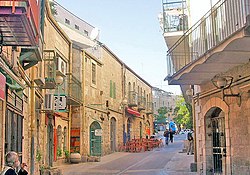 Nahalat Shiv'a:
A neighborhood of seven pioneers.
This picturesque neighborhood was the result of an agreement among seven members of the Jewish community. The name reflects this union: shiv'a (שבעה) means “seven” and nahala (נחלה) means “inheritance.”
These seven pioneers managed to raise the funds to purchase land outside the walls of Jerusalem and build a house for each of them and their families. The houses extended toward the road to Jaffa, allowing them to establish businesses along this main route and secure a source of income.
Nahalat Shiv'a became one of the first Jewish neighborhoods outside the walls and marked an important step in Jerusalem’s urban expansion during the 19th century. -
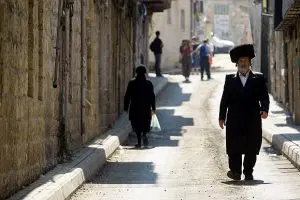 Mea Shearim:
The religious neighborhood.
This unique and picturesque neighborhood, called Mea Shearim (מאה שערים = “a hundred measures”), takes its name from the verse in Genesis 26:12, which was read on the day the neighborhood was founded. The verse says:
“Isaac sowed in that land and reaped a hundredfold that year, because the Lord blessed him.”
The neighborhood’s design was the work of German Protestant architect Conrad Schick, whose house is located on the Street of the Prophets. Architecturally, Mea Shearim was built as a wall of houses forming a closed compound that provided security and community cohesion.
Today, this neighborhood is home to the religious Jewish community, especially followers of traditions from Lithuania, known for their traditional lifestyle and deep adherence to Jewish law.