-
Historia
At the end of the 6th century and the beginning of the 7th, major changes occurred in the world, especially from the southern Levant, what we now know as Saudi Arabia. There, Muhammad led a spiritual and historical revolution that gave birth to Islam.
Muhammad died in the year 632 without leaving blood heirs, but he did leave behind disciples: the four Caliphs (خليفة, in Arabic *Khalifa*, meaning "substitutors"). These four Caliphs of the Righteous Path or The very first substitutors (ٱلْخِلَافَةُ ٱلرَّاشِدَةُ = *Al-Khilafa Al-Rashida*) followed in Muhammad’s footsteps until the last of them, Ali, who leaded a sectarian division known as Shiism (شيعة, meaning "faction") againts the other dynasty who took over the islam world called the Umayyad Caliphate.
In the year 638, the second Caliph, Omar ibn al-Khattab, conquered the Land of Israel, taking it from the Byzantines. Thus began a new era: the first Muslim period. It is the first, because there would also be a second... and a third.
As we explore Jerusalem in search of Muslim traces, we will encounter remnants from all three of these historical periods. -
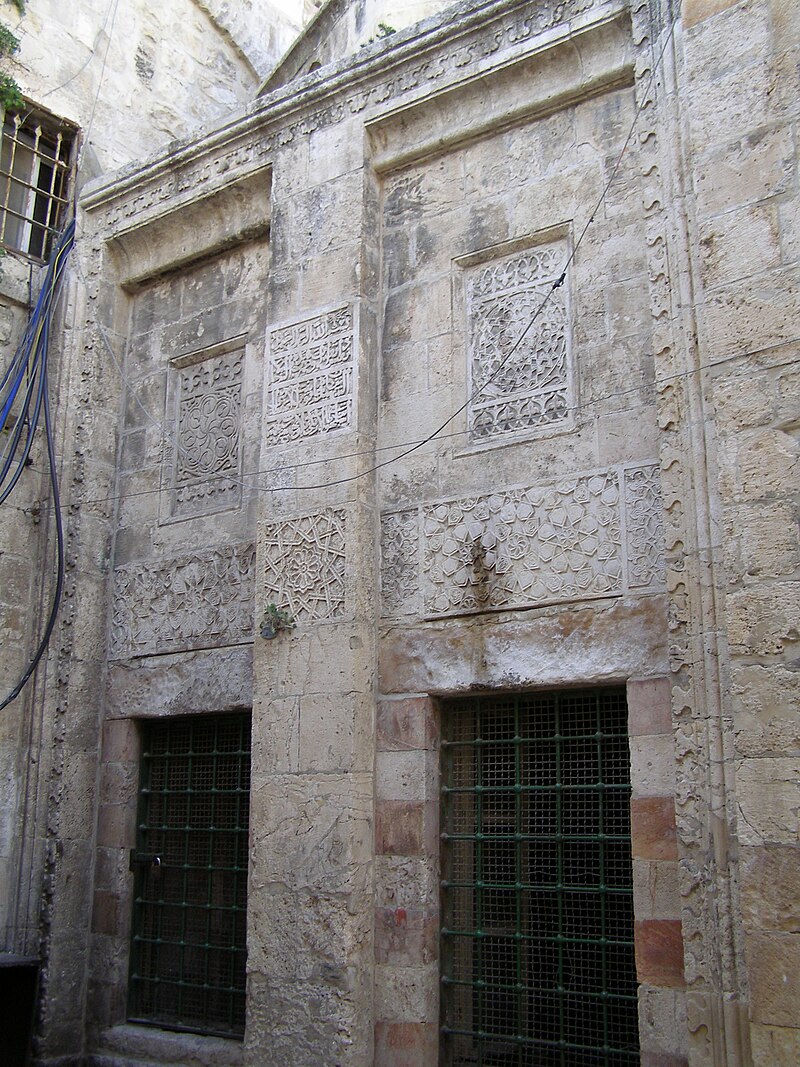 HaShalshelet Street (The Chain Street)
Main street of the Muslim Quarter featuring buildings left by the Mamluks from the 13th and 14th centuries.
The Crusaders lost control of Jerusalem to the Ayyubids in 1187 when Saladin (Salah ad-Din) defeated Guy de Lusignan at the Battle of Karnei Hittin. The Ayyubid dynasty was another Muslim dynasty originating from Persia. Nevertheless, the Crusaders managed to return until 1260, when the Mamluks took over Jerusalem and permanently expelled the Christians, not only from the city but from all of the Holy Land.
Who were the Mamluks?
During the Abbasid dynasty, based in Iraq, it was crucial to have a strong army to maintain dominance. Inspired by their Roman predecessors, the Abbasids adopted the practice of training soldiers from childhood. They kidnapped children from pagan villages, converted them to Islam, and trained them as warriors, especially in Egypt. The term "Mamluk" comes from the Arabic *mamlūk* (مملوك), meaning “military slave.” As the proverb goes: “Raise ravens and they’ll peck out your eyes”, a phrase that seems inspired by them. The Mamluks became such a powerful army that they no longer needed external control. Baibars, the most prominent Mamluk leader, arrived in the Land of Israel in 1260. His emblem, two lions, can be seen in various places across the country. Since Jerusalem was not the Mamluk capital, it mainly received leaders expelled from their ranks. That’s why on this street, HaShalshelet (השלשלת, “The Chain”), we find a series of houses, mausoleums, and madrasas (Islamic schools) that belonged to these exiled leaders, known as *Batals*. -
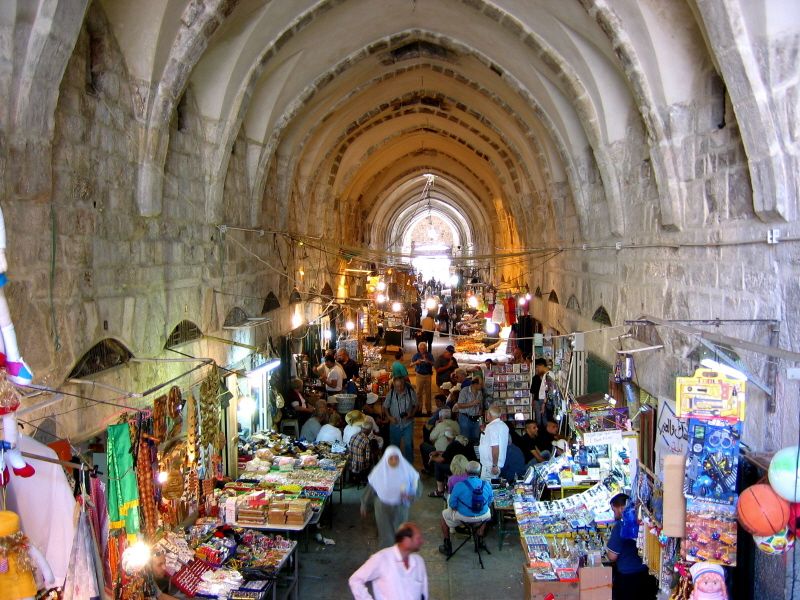 Cotton Market (Shuk HaKutna)
14th-century Mamluk market for cotton producers.
An ancient market founded by the Mamluk governor Tankiz during the 14th century, one of the *Batal* leaders who was expelled after a dispute with the sultan. This market is directly connected to the path leading to the Temple Mount, where the famous Dome of the Rock is located. It was built over the ruins of an old Crusader market, which was destroyed during the Mamluk Muslim incursion.
-
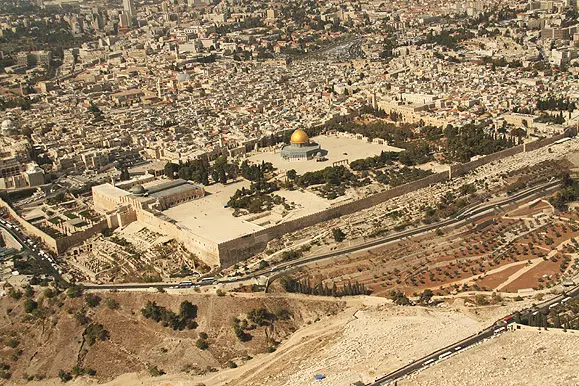 Temple Mount Esplanade
The Temple Mount, where the First and Second Temples of Jerusalem once stood.
This 15-hectare esplanade is a monumental complex that bears the marks of Roman destruction in 70 CE and Muslim transformation in the 7th century. Yet its stones preserve the legacy of King David, the First Temple of Israel, Solomon’s Temple, and the Second Temple, whose last major renovation was carried out by King Herod.
Despite its destruction, this site has witnessed centuries of wars and conquests, from the Crusaders to the Muslims, and remains a living symbol to this day.
First Temple: King David purchased the field of Araunah the Jebusite, where his son, King Solomon, built the First Temple.
Babylonian Period: The temple was destroyed during the Babylonian occupation in 586 BCE.
Persian Period: Cyrus (כורש = Koresh in hebrew) the Great, emperor of Persia, allowed the people of Israel to return to the Land of Israel, and in 516 BCE the Second Temple was built.
Greek Period: The temple was seized by Antiochus IV Epiphanes of the Seleucid dynasty, sparking the Hasmonean revolt in 164 BCE.
Hasmonean Period: The temple was purified and expanded on the day commemorated as Hanukkah (חנוכה = “dedication” in Hebrew), both internally and in its surrounding walls (until 64 BCE).
Herodian Roman Period: The temple was rebuilt and enlarged; the walls visible today date from this period (until 70 CE).
Roman Period: The temple was destroyed and remained unused until 134 CE, following the Bar Kokhba revolt.
Post-Bar Kokhba Roman Period: Emperor Hadrian built a temple dedicated to Jupiter on the esplanade.
Byzantine Period: The esplanade remained empty until the arrival of the Muslims in 638. The second caliph, Omar ibn al-Khattab, built a modest mosque at the southern end of the esplanade, known as Al-Aqsa (الْأَقْصَى, “the farthest”).
Early Muslim Period: Under the Umayyad dynasty, Caliph Abd al-Malik built the Dome of the Rock in 691 CE, on the site of the former temple. His son Al-Walid later rebuilt the Al-Aqsa Mosque.
Crusader Period: In 1099, the Crusaders converted the Al-Aqsa Mosque into Solomon’s Temple (hence the name of the Knights Templar), and the Dome of the Rock into the Templum Domini (“Temple of the Lord”).
Ayyubid–Mamluk Period: The Ayyubid dynasty expelled the Crusaders from Jerusalem, restoring Muslim control. With the arrival of the Mamluks, Christian dominance in Jerusalem came to an end.
State of Israel Period: Although Jerusalem is the official capital of the State of Israel, a status quo is maintained: Jordan oversees the Islamic holy sites on the esplanade, while the State of Israel is responsible for the security of the entire complex.