-
Historia
Although the Roman period began in 64 BCE when Pompey arrived in Jerusalem at the request of the Hasmoneans to resolve the dispute between Queen Shlomzion Alexandra’s sons, Aristobulus II and Hyrcanus II, and later Herod became a client king under Roman rule, the people of Israel retained a degree of political autonomy and, most importantly, full jurisdiction over the Temple. When Jerusalem fell to Titus, son of Vespasian, in 70 CE, the Roman era began in all its social and administrative dimensions. Meanwhile, Christianity was gaining strength despite Roman repression and persecution. This continued until Emperor Constantine the Great, who dreamed of fighting his rivals under the sign of Christ. In 312 CE, Constantine issued an edict allowing Christian faith, and in 324 CE he declared it the official religion of the Empire, marking the beginning of the Byzantine era.
-
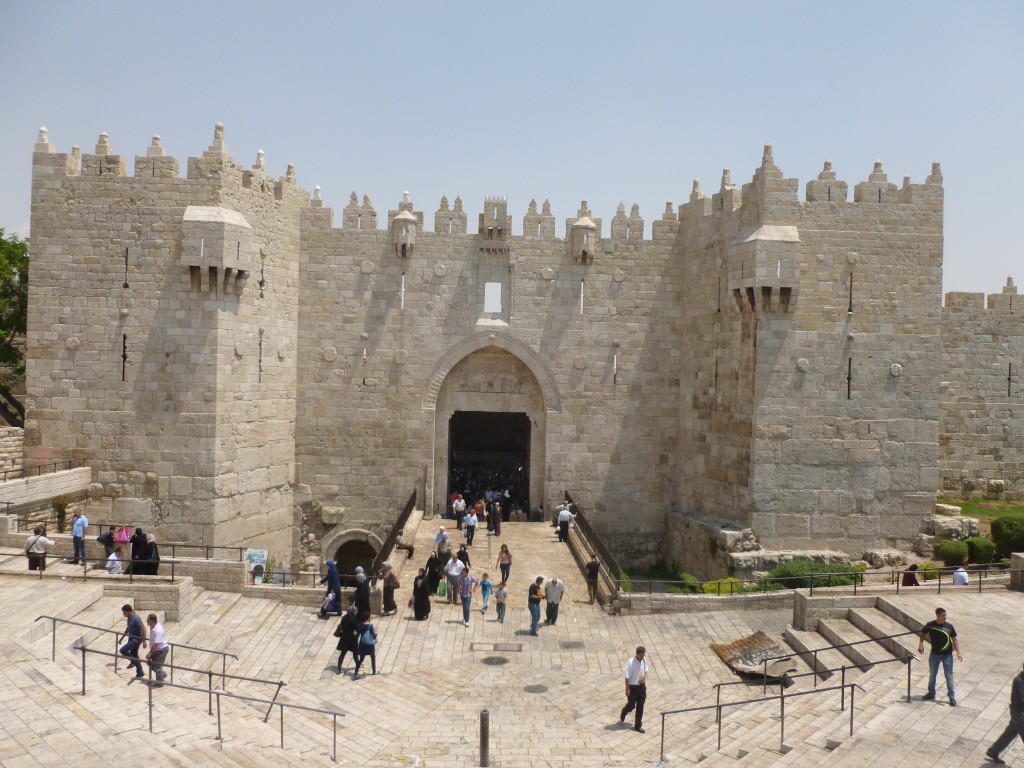 Damascus Gate:
The central northern gate of Jerusalem.
This impressive structure hides within its stones the triumphal arch of Emperor Hadrian, built after the conquest of Jerusalem in 132 CE, when the city was renamed Aelia Capitolina. Some scholars believe this event contributed to the Bar Kokhba revolt. Damascus Gate, also known as Shechem Gate (שער שכם in Hebrew), is called Bab El-Amud (باب العامود) in Arabic, meaning "Gate of the Column." What column does it refer to? Behind this gate stood a Roman column, likely supporting a statue of Hadrian himself. Some researchers suggest this column served as a reference point for measuring distances. In a 6th-century church in Madaba, Jordan, a mosaic floor was found depicting Christian holy sites in the Land of Israel. In the section showing Jerusalem, the Damascus Gate is clearly illustrated with a column.
-
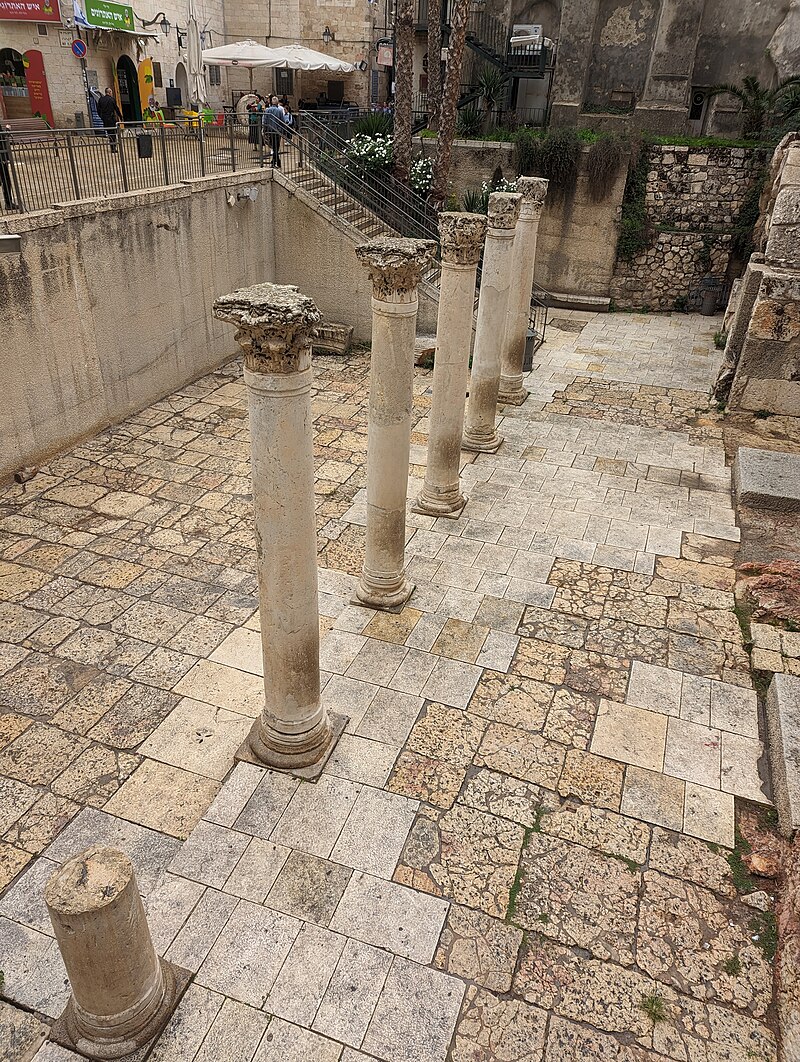 Roman Cardo:
Byzantine road from the 4th century CE.
In 132 CE, under Emperor Hadrian, Jerusalem became a Roman city: "Aelia Capitolina." Like all Roman cities, Jerusalem had a main street running north to south, known as the Cardo. Due to the city’s unique layout, Jerusalem had two cardines (plural of cardo): the Cardo Maximus, which extended to the Church of the Holy Sepulchre and was expanded by Emperor Justinian in the 6th century to reach the church he built, Agia Nea; and the Cardo Valensis, which connected to the road leading to the City of David (Tyropoeon Valley). The photo shows part of the Byzantine extension of the Cardo.
-
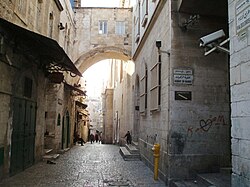 Ecce Homo Arch:
Pontius Pilate presents Jesus to the crowd: "Behold the man."
The Ecce Homo Arch is named after the words attributed to Pontius Pilate when presenting Jesus to the crowd: “Ecce Homo”, “Behold the man.” This arch, part of a monumental Roman gate built by Emperor Hadrian in the 2nd century CE, is now part of the Sisters of Zion Monastery complex. Beneath its foundations lie remnants of a Roman road and ancient cisterns, silent witnesses to Jerusalem’s transformation into Aelia Capitolina.
John 19:5
-
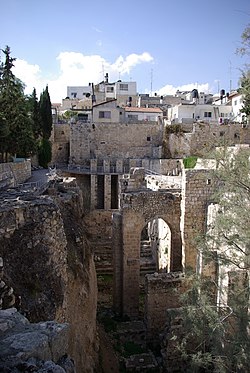 Pool of Bethesda:
The Probatica pool (Πρόβατικα in Greek = of the sheep). A healing pool.
The Pool of Bethesda (בית חסדא Beit Hesda), mentioned in the Gospel of John as the site of one of Jesus’ miraculous healings, gained new significance during the Byzantine period.
Roman Period: When Hadrian proclaimed Jerusalem as Aelia Capitolina, healing pools were built here in honor of the god of medicine, Asclepius (Ἀσκληπιός).
Byzantine Period: In the 5th century, over the ruins of the ancient pool, the Byzantines built a majestic basilica dedicated to Saint Mary, separating the two pools. The church was destroyed in 614 CE with the arrival of the Sassanids. Its remains can still be explored today, along with the double pools and their feeding channels.
Crusader Period: After the Sassanid destruction, part of the church was rebuilt but later destroyed by El-Hakim Bi-Amr Allah in 1009 CE. The Crusaders built another church over the ruins and a separate church dedicated to Anne, mother of Mary, believing this to be Mary’s birthplace.
Ayyubid Period: The church over the pool was destroyed, but the church dedicated to Anne survived by being converted into a madrasa (Islamic school).John 5:1-9