-
Historia
The term *Wadi* (وادي = Arabic for “valley”) refers here to the Prat River (נחל פרת = Nahal Prat in Hebrew). This valley serves as one of the natural entryways into the Land of Israel from the Jordan River, due to its proximity to the site where, according to the Old Testament, Joshua Bin Nun (Yehoshua) led the people of Israel across the Jordan River. According to the New Testament, John the Baptist baptized Jesus in this area. Nearby, there are several historically significant sites, some of which we’ll explore here.
-
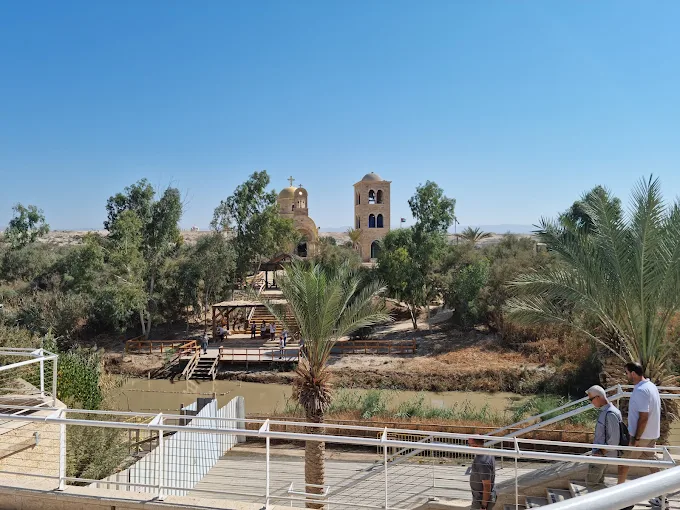 Qasr El-Yahud
Site of Jesus’ baptism in the Jordan River.
Qasr El-Yahud (قصر اليهود = Arabic for “Castle of the Jews”) is located on the modern border between Israel and Jordan. It is considered a biblical site where two major events took place. The first, and perhaps the reason for the second, is the crossing of the Jordan River by Joshua (יהושע בן נון = Yehoshua Bin Nun in Hebrew) and the people of Israel, as commanded by Moses, who died on Mount Nebo (on the Jordanian side).
Is this the correct location?
There is no archaeological evidence confirming this exact spot, but several elements strongly suggest it could be.
Proximity to Jericho: According to the Bible, the Israelites faced and destroyed the walls of Jericho after crossing the Jordan River. While no physical evidence of Jericho’s walls has been found, the city’s proximity to this site is undeniable.
Crossing the Jordan River: Every year, despite its strong flow, the Jordan River experiences a seasonal drop in water levels, especially from Passover through the hot summer months (July and August), making it possible to cross on foot.
Jesus’ Baptism Site: According to the New Testament, after being baptized and recognized by God as His son, Jesus spent 40 days confronting the devil, who tried unsuccessfully to tempt him. Tradition places this event on Mount Qarantal, also known as the Mount of Temptation (جبل لقرنطل = Jabel Quruntul in Arabic), referring to the 40 days of isolation and abstinence.Joshua’s crossing of the Jordan River: Joshua 3:15–16
Jesus’ baptism in the Jordan River: Matthew 3:13–17
Mount of Temptation: Matthew 4:1–11, Mark 1:12–13, Luke 4:1–13 -
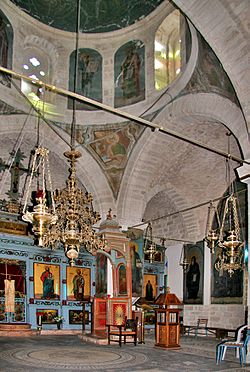 Dir Hagle
Monastery of Saint Gerasimus.
Dir Hagle (دير الحجلة = Arabic for Dir Hagle, בית חגלה = Beit Hogla in Hebrew) is a biblical city mentioned as part of the tribal boundaries of Judea.
The hermit monk movement is believed to have originated in Egypt during the 3rd century, promoting voluntary isolation as a way to emulate the spiritual experiences of biblical prophets, especially Jesus, through abstinence and detachment from worldly pleasures.
Gerasimus arrived in the Land of Israel in the 5th century and established his *Laura* (a hermit settlement devoted to God) here.
Legend tells of Gerasimus encountering a lion suffering from a thorn in its paw. He healed the lion, which became his gentle companion. Later, merchants passing through the monastery accused the lion of stealing their donkey. The lion found the donkey and returned it to the merchants.
The lion was named Jordan.
This monastery and the ideology of Saint Gerasimus and his monks emphasize the possibility of transformation: the fierce lion becomes tame. Inside the church, one can find depictions of the transformation of Mary of Egypt, a sinner who receives the blessing of Mary, mother of Jesus, and is allowed to enter the Holy Sepulchre. According to Christian tradition, Mary of Egypt, originally from Jerusalem, lived and died in this monastery.
Remains of a Byzantine mosaic were found within the monastery.
The city is also mentioned on the Madaba Map.